What a bet actually costs you
Picture $100 in the pot. Your opponent fires out $50, which makes it $150, and calling costs you $50. So you're paying 50 to win 150. That's 3-to-1.
Turn it into a percentage by dividing your call by the pot you'd be calling into, counting your own money: 50 over 200 is 25%. That's your break-even equity. Win more than a quarter of the time and the call makes money over the long haul. Win less and you're better off letting the hand go.
A few sizes come up constantly, so it pays to know them cold. Half the pot, and you need about 25%. Full pot, about 33%. Overbet twice the pot and it's about 40%. Once those stick, decisions get a lot faster.
Count your outs, then convert
Equity is your chance of winning the hand. When you're drawing, you can estimate it by counting your outs, the cards that complete your hand.
A flush draw has nine outs, since there are 13 cards of a suit and you can see four. An open-ended straight draw has eight. A gutshot has four. Then use the rule of 4 and 2: with two cards to come, multiply your outs by 4, and with one card to come, multiply by 2.
On the flop, a flush draw works out to roughly 36% by the rule (the exact figure is about 35%). On the turn, it's roughly 18%, and the exact number is about 19.6%. The shortcut runs a touch generous with many outs, but it's close enough to decide a hand.
The same draw, two different decisions
Here's why this matters. You hold a flush draw on the flop. The pot is $100 and your opponent bets $50. You need 25%, and you have about 35%. Calling is clearly correct on the numbers.
Now the turn comes and you miss. Your opponent bets $50 into a pot that's grown to $200. This time you need about 17% ($50 divided by the $300 total), and with one card left you have about 19.6%. A slim edge, but still a call.
Now say that same turn bet is $100 into $200. You need 25% (that's $100 divided by $400) but you only have 19.6%. On pure pot odds, that's a fold, unless something else makes up the difference. The hand didn't change. The price did, and that's the entire point.
Implied odds, and when they lie to you
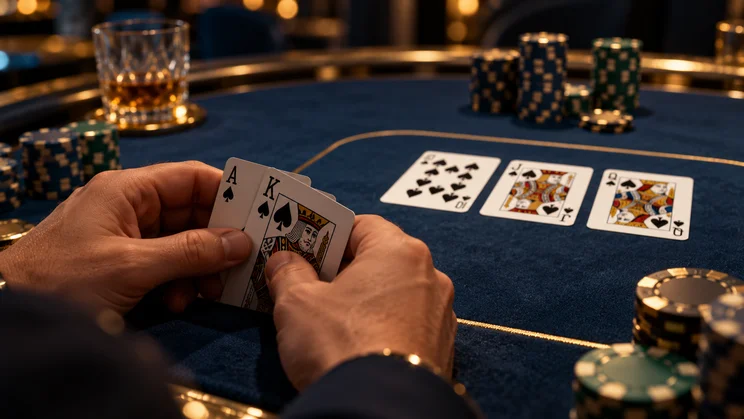
That "something else" is implied odds, the money you can win on later streets when your card shows up. If your opponent is deep and will happily pay you off when the flush hits, a call that's a little short on pot odds can still work.
Be honest with yourself here, though. Hidden draws, deep stacks and clean outs make implied odds good. A paired board makes them worse, since your flush might run into a full house, and drawing to the second-best flush gets expensive fast. This is often overrated by most players. You remember winning large pots but forget when you lose small ones. If you want to justify calling for implied odds, think about how much you would need to win on the river, and if your opponent will be willing to pay.
Drilling it until it's automatic
Nobody's doing long division mid-hand. The work happens off the table. Take a few common bet sizes, figure out the equity each one needs, and drill them until you don't have to think. A free equity calculator is handy for testing your gut, and going back over hands you played is where most of the real improvement comes from.
It also helps to play somewhere that makes reviewing easy. If you're comparing rooms, onlinesportsbetting.net has a Lucky Rebel review that covers its small browser-based poker room, its banking and its licensing, helping players understand what to expect when choosing a platform. Players who put in more volume may also want to compare traffic levels and rewards.
The takeaway
Mastering poker draws requires comparing pot odds—the cost of a call divided by the total pot—against your hand's equity, which is estimated by multiplying your winning outs by four the flop or two on the turn. While potential future winnings can occasionally justify mathematically short calls, consistent profitability comes from memorizing the break-even percentages for common bet sizes. By drilling these baseline calculations off the table until they become automatic, you can consistently make profitable, math-based decisions in real time without relying on guesswork.