
For years, that simple job involved far too much messing around. You entered a card number, waited for the bank screen, went looking for a security code and hoped the casino did not reject the whole thing for no clear reason.
It was annoying for everyone, but especially for poker players. A slot will still be there in an hour. A poker tournament may have closed registration by then.
UK casinos have improved this part quite a lot. Open banking now lets players approve deposits inside the same banking app they already use every day. It is quicker, feels familiar and removes most of the typing. The strange thing is that withdrawals still do not always feel anywhere near as simple.
The Cashier Used to Get in the Way
Let’s say a £22 tournament starts at 8 pm. You have £14 left in your casino account, so you only need another £8 to enter.
That should take seconds. Instead, the card has expired, the replacement card is upstairs and the bank sends a security code to an old phone number. By the time it is sorted, late registration has five minutes left.
This is not some huge banking disaster. It is just enough friction to ruin the reason you wanted to deposit in the first place.
The choice of card payments also became smaller after 14 April 2020. That was when the UK Gambling Commission banned credit card gambling at licensed casinos, poker rooms and betting sites.
The rule also stops players from moving credit card money through an e-wallet and then using it to gamble. Debit cards still work, but casinos needed another quick option that did not depend on the usual card form.
Direct bank payments were the obvious answer. The UK already had the banks, apps and payment network in place. The casino industry just had to make the journey less awkward.
Pay by Bank Is Basically a Prepared Bank Transfer
“Open banking” sounds more technical than it feels when you actually use it. From the player’s side, it is a bank transfer where almost everything has already been filled in.
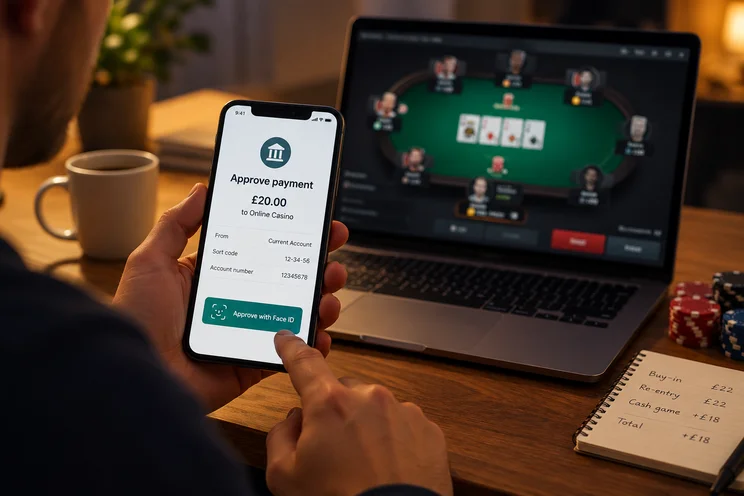
You choose Pay by Bank in the cashier, enter £20 and pick your bank. The banking app opens with the amount and recipient waiting for you. Check the details, approve with Face ID or a passcode and go back to the casino.
That is it when it works properly. No card number, no new wallet account and no casino asking you to copy a long payment reference.
The money normally moves through the UK’s Faster Payment System. These payments are usually available almost immediately, although some can take up to two hours. The central system tells the bank within 15 seconds whether the payment was accepted or rejected.
That last part is useful. Even when a deposit fails, it is better to know now than stare at “pending” while wondering if you should try again.
Noda Makes the Mobile Part Much Better
Noda is one of the payment providers using this setup at online casinos. It connects the casino cashier to supported banks, including names such as Barclays, HSBC, Lloyds, NatWest and Revolut.
There is no separate Noda account to create. That alone gives it an advantage over e-wallets if you only want to make a quick deposit and start playing.
Oddly, there still are not many UK casinos offering it. I am not entirely sure why because the payment itself is quick, simple and a good fit for anyone already using mobile banking. My guess is that many casinos already have debit cards, Trustly and other bank payment systems connected. Adding another provider takes time and money, even if it gives players a better choice.
I had to look around a bit to find out which casinos actually support Noda. I eventually found Casino Banking Methods, which has created a collection of UK casinos with Noda payments and checked how the method works at each one.
That saves you from opening casino after casino just to search the cashier. It is also useful because one site may allow Noda deposits and withdrawals, while another may only accept it when money is coming in.
A Shared Casino Balance Is Handy, Until It Isn’t
Many gambling sites no longer keep poker money in a completely separate corner. The same account balance may cover poker, slots, live tables and sports bets.
That is handy if poker is your main game and you only use the other sections now and then. Deposit once, find the table and there is no second transfer between wallets.
It can also make a messy session look much cleaner than it really was. You deposit £100, enter two tournaments, play a few hands of blackjack during a break and finish with £72. The cashier only shows £100 in and £72 left. It does not explain where the £28 went.
For casual play, that may not matter much. For anyone trying to track poker results, it matters a lot.
It’s better to keep a simple note with tournament buy-ins, re-entries, cash table results and withdrawals. Nothing fancy is needed. Even a note on your phone is better than treating the casino balance as a poker profit tracker, because it usually is not one.
The Withdrawal Is Where a Casino Shows Its True Colours
Casinos enjoy telling players that deposits are instant. That is hardly surprising. Taking money quickly is the easy half of the job.
The more useful question is what happens when you ask for £300 back. Does the casino approve it the same day? Does it support the same bank method? Does it suddenly discover that it needs three documents it never mentioned before?
Noda can handle payments in both directions, but the casino decides what appears in its cashier. If Noda withdrawals are not available, the payout may be sent through a standard bank transfer or another verified method.
Using one bank account in your own name keeps this much cleaner. Depositing through a partner’s card, a second wallet and then a different bank account may feel flexible at first. At withdrawal time, it can turn into a pile of ownership checks.
There is a fair reason for some of those checks. Casinos need to know who owns the account and where the money came from. What they should not do is ignore basic verification until a player has won.
The Best Cashier Is Quiet
A genuinely good casino cashier is not the one with the most payment logos. It is the one that answers the obvious questions before you have to ask support.
What is the minimum deposit? Is there a fee? Will the money arrive now? Can the same method be used for a withdrawal? How long does the casino take to approve one?
Open banking providers such as Noda have made the deposit side much smoother. For poker players on mobile, it is a big improvement over typing card details or setting up a manual bank transfer.
Still, the job is only half done if withdrawals remain slow or confusing. Any casino can build a nice button for taking £20. The better ones also explain how that £20, or whatever the player wins with it, gets back to the bank.