Tournament poker repeats this process across successive hands. Chips move between players, the field changes, and each new deal starts another sequence of decisions. Within a hand, information arrives through channels: the cards a player holds, the cards everyone can see, and the actions taken around the table. These channels reveal different things and cannot be treated as interchangeable.
A series such as the Golden Spade Poker Open brings separate tournament events together. Within Hold’em competition, the movement from private cards to a shared board gives each hand its own progression. The tournament schedule describes the larger event, while the developing hand determines what players can see at each decision. Each deal starts with private cards, adds shared cards in stages, and records decisions made while some information remains concealed.
Private Cards and Public Information
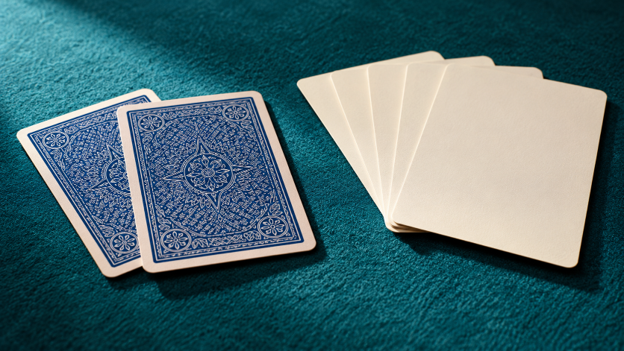
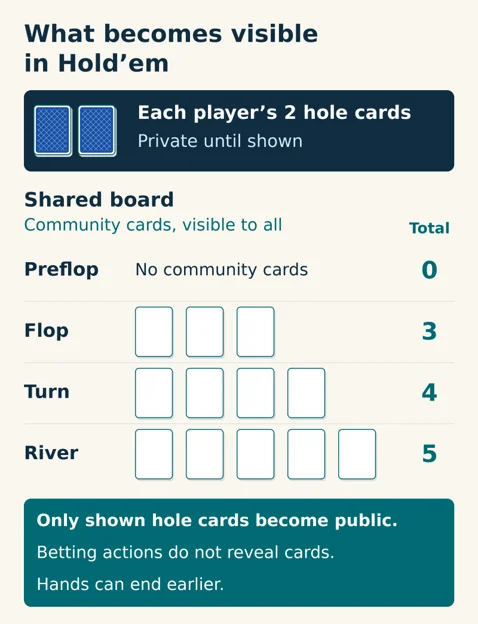
Each player receives two hole cards, dealt face down. Those cards are available to their holder, while the opponents’ cards remain concealed. This is the basis of poker’s imperfect information: a player makes decisions without seeing the complete card situation.
The community cards are different. Once dealt, they are visible to everyone still involved and available for making a five-card hand. A shared board does not necessarily give every player the same hand. Its ranks and suits establish common possibilities, while the hole cards can contribute differently to the combinations available. The visible cards alone do not establish exactly how each opponent can use them.
What the Flop Adds
Before the flop, no community cards are visible. Players have their hole cards and the preflop action to consider. The four betting rounds of Hold’em provide the sequence through which the hand develops: preflop, flop, turn, and river. A hand can finish earlier, so reaching the full board is a possible progression rather than a requirement for every deal.
The flop reveals the first three community cards together. With their two hole cards, each player now has five cards from which to form a hand. Repeated ranks and matching suits on the board become visible features of that hand’s development. The flop also leaves two community cards still to come, so the current combination and the eventual combination may differ. The cards already dealt establish the present picture; the undealt cards remain unknown.
The Turn and River Complete the Board
The turn adds the fourth community card. It may become part of a player’s best available combination or leave that combination unchanged. It becomes available to every opponent still in the hand. Its relevance cannot be assessed solely through the cards one player holds, because the shared board belongs to all of them.
The river adds the fifth community card after the turn stage. At that point, the board is complete. Each remaining player has access to seven cards: their two hole cards and the five on the table. The hand used for comparison consists of the best five-card combination available. It can use both hole cards, one, or neither. Using the board alone means that all five cards in the player’s hand are public.
The way those five cards are selected also explains why different starting cards can produce equal hands. Cards outside the best five do not decide the comparison. Equally ranked five-card hands tie, even when the players’ unused cards differ. The full collection of seven cards and the five-card hand used at showdown are therefore distinct.
What Actions Reveal and Leave Unknown
Betting actions add another kind of information. A check, bet, call, raise, or fold is an observable choice made within the hand. Players can follow which actions occurred and how much was committed. Unlike the board, an action does not display a card’s rank or suit.
Information also depends on when a decision is made. A player acting later in a betting round has already seen the earlier actions in that round. A player acting first has not. The board is equally visible to both, but the record of betting develops as people take their turns. The same public cards have a changing context as the action proceeds. In her account of poker decision-making, Maria Konnikova describes responding to the evolving situation at the table.
A call commits chips in response to an outstanding wager, while a fold removes that player from the hand. A check passes the action without adding chips to the pot. These actions do not identify the cards involved. Blind postings are different: they are required before players receive their hole cards. Posting a blind therefore does not itself express a choice based on starting-hand strength.
Hole cards shown at showdown allow the disclosed hands to be compared. That disclosure supplies something the betting alone could not establish: the actual ranks and suits of those private cards. An unshown hand remains undisclosed, even after the board is complete.
One Hand Within a Tournament
The next deal begins the information sequence again with new hole cards. The tournament carries its accumulated chip positions forward, while the individual hand introduces a new private and public card situation. Following tournament poker therefore involves two connected developments: the continuing competition between hands and the changing information inside each one.