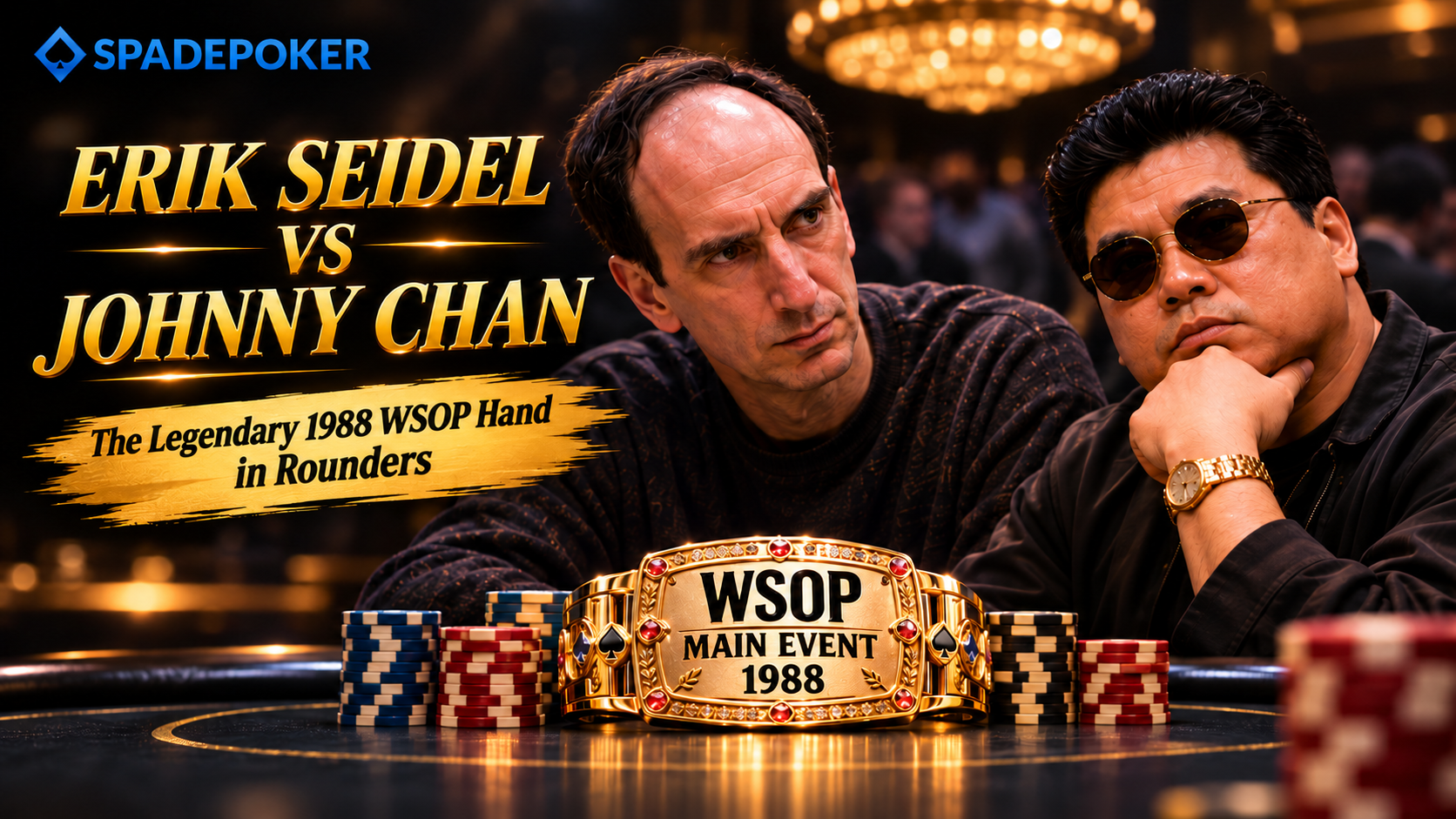
One of the most famous hands in poker history ended with Johnny Chan winning the 1988 World Series of Poker Main Event and Erik Seidel watching his world championship dream disappear. A decade later, the same hand appeared in the opening scenes of Rounders, introducing an entirely new generation to one of poker's greatest confrontations.
For Chan, the hand completed a remarkable back-to-back WSOP Main Event triumph. For Seidel, it was a painful defeat in one of his first major tournament appearances. Yet the story did not end at Binion's Horseshoe in 1988. Seidel would go on to become a ten-time WSOP bracelet winner and one of the most successful tournament players in history.
How did the legendary hand unfold, why did Seidel move all-in against Chan's unbeatable straight, and how did Hollywood turn the moment into poker immortality?
Erik Seidel vs Johnny Chan: The 1988 WSOP Main Event
In May 1988, the World Series of Poker was a very different event from the global spectacle it is today. The Main Event took place at Binion's Horseshoe in downtown Las Vegas, with 167 players paying the 10 000$ buy-in.
Johnny Chan arrived as the defending world champion. He had won the 1987 Main Event and was attempting to become the latest player to successfully defend poker's most prestigious title.
Standing in his way was Erik Seidel, a 28-year-old New Yorker whose background included competitive backgammon and financial trading.
Seidel was not yet the poker legend we know today. His second-place finish in the 1988 Main Event would become the first major result of an extraordinary career.
| 1988 WSOP Main Event | Details |
| Location | Binion's Horseshoe, Las Vegas |
| Buy-in | 10 000$ |
| Entries | 167 |
| Champion | Johnny Chan |
| First-place prize | 700 000$ |
| Runner-up | Erik Seidel |
| Second-place prize | 280 000$ |
Who Was Erik Seidel Before the 1988 WSOP?
Before becoming one of poker's most accomplished professionals, Erik Seidel followed an unconventional path into the game.
Born in New York City in 1959, Seidel developed his competitive instincts through backgammon, a game requiring probability, strategic thinking and the ability to make decisions under uncertainty.
He also worked in financial markets, where managing risk and evaluating incomplete information were part of everyday life.
Those experiences translated naturally into poker.
By the late 1980s, Seidel was playing in New York's poker scene, including the famous Mayfair Club, which became associated with several influential poker professionals.
But competing against the world's strongest players in the WSOP Main Event was a different challenge.
Seidel entered the 1988 tournament without the championship experience of opponents such as Johnny Chan, T.J. Cloutier and Humberto Brenes.
He nevertheless survived the field and reached heads-up play for the world championship.
Johnny Chan Was Chasing Back-to-Back World Championships
Johnny Chan had already established himself as one of the most dangerous tournament players of the era.
Nicknamed the "Orient Express," Chan was known for his aggressive style, confidence and ability to exploit opponents' mistakes.
His 1987 WSOP Main Event victory had earned him 625 000$ and his first world championship title.
Returning in 1988, he faced the pressure of defending that achievement.
Winning consecutive Main Events was exceptionally rare. Doyle Brunson had achieved the feat in 1976 and 1977, while Stu Ungar followed in 1980 and 1981.
Chan now had an opportunity to join that exclusive group.
After surviving the final table, only Seidel remained between him and poker history.
The 1988 WSOP Main Event Final Table
The tournament featured several players who would become major figures in poker history.
| Position | Player | Country | Payout |
| 1 | Johnny Chan | USA | 700 000$ |
| 2 | Erik Seidel | USA | 280 000$ |
| 3 | Ron Graham | USA | 140 000$ |
| 4 | Humberto Brenes | Costa Rica | 77 000$ |
| 5 | T.J. Cloutier | USA | 63 000$ |
| 6 | Jim Bechtel | USA | 49 000$ |
One particularly interesting name is Jim Bechtel, who would return five years later to win the 1993 WSOP Main Event.
But in 1988, the tournament's defining moment belonged to Chan and Seidel.
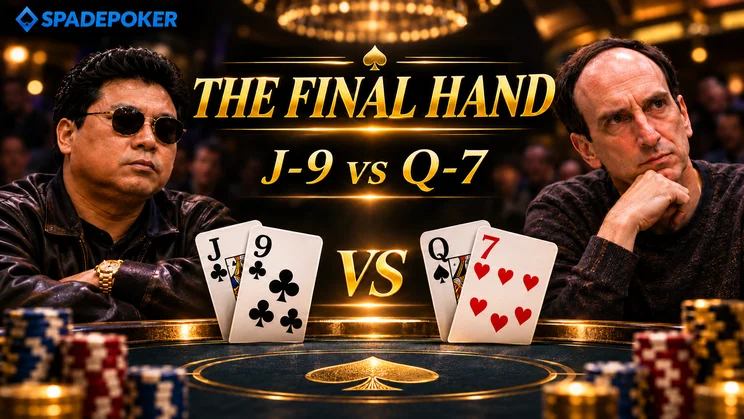
The Famous Final Hand: Johnny Chan's J-9 vs Erik Seidel's Q-7
The final hand of the 1988 WSOP Main Event has become one of the most frequently replayed moments in poker history.
Chan held J-9 suited in clubs.
Seidel held Q-7 offsuit.
Both players saw the flop, which came Q-10-8.
The flop created a remarkable confrontation.
Seidel had top pair with his queen. In heads-up poker, that is often a strong holding.
Chan, however, had flopped the nut straight.
Seidel was already in serious trouble, and the way the betting developed would make the situation even more dangerous.
Flop: Chan Hits the Nut Straight
On the Q-10-8 flop, Chan's J-9 completed a queen-high straight.
Seidel's Q-7 had connected with top pair.
Chan bet 40 000$ and Seidel raised by another 50 000$.
Instead of reraising with his powerful hand, Chan called.
That decision was crucial.
By calling rather than immediately applying maximum pressure, Chan kept Seidel involved in the pot and concealed the full strength of his holding.
From Seidel's perspective, Chan could still have been holding several different hands, including draws and weaker made hands.
Chan had created an opportunity to win an enormous pot if Seidel continued betting.
Turn: The Trap Gets Stronger
The turn brought a deuce.
It did not improve Seidel's hand or change Chan's straight.
Both players checked.
For Chan, the check was another opportunity to disguise his hand. For Seidel, the absence of another bet left room to believe that his pair of queens might still be good.
The critical decision was now waiting on the river.
River: Seidel Moves All-In
The river was a six.
The final board read Q-10-8-2-6.
Chan still held the nut straight.
Seidel still had one pair.
Seidel moved all-in.
Chan called immediately and revealed J-9, ending the tournament.

Johnny Chan had successfully defended his WSOP Main Event title, earning 700 000$ and joining the select group of back-to-back world champions.
Seidel finished second for 280 000$.
Neither player could have known that this particular hand would become famous far beyond the poker community.
Did Erik Seidel Make a Terrible Mistake?
Viewed with full knowledge of both players' cards, Seidel's river shove looks disastrous.
He committed his remaining chips with a single pair against an opponent holding the nut straight.
But poker decisions cannot be judged solely by the cards revealed at showdown.
Seidel did not know that Chan had flopped a straight. He had to interpret Chan's betting line, estimate his possible holdings and decide how to play his own hand.
Chan's flop call and turn check helped conceal the strength of his hand.
That does not automatically make Seidel's river shove correct. A modern strategic analysis would need to consider stack sizes, pot size, betting ranges and the tendencies of both players.
What makes the hand historically significant is the combination of Chan's trap, Seidel's commitment and the extraordinary stakes.
It was the final hand of a world championship, not an ordinary cash-game confrontation.
Why the Hand Became Famous in the Movie Rounders
Ten years after the 1988 WSOP Main Event, the poker film Rounders was released in 1998.
Starring Matt Damon as Mike McDermott and Edward Norton as Lester "Worm" Murphy, the movie followed two young poker players navigating New York's underground gambling world.
The opening sequence features real footage from the 1988 WSOP Main Event, showing Johnny Chan defeating Erik Seidel.
For McDermott, Chan represents the highest level of professional poker, and the famous hand becomes part of the film's introduction to the game's psychology and ambition.
Johnny Chan also appears in the movie as himself.
The inclusion of the real WSOP footage connected the fictional story to authentic poker history.
For viewers discovering poker through Rounders, Seidel became instantly recognizable as the player on the losing side of one of the game's most memorable traps.

How Rounders Changed the Legacy of the 1988 Final Hand
The hand was already significant because it decided a WSOP world championship.
But Rounders introduced it to audiences who might never have watched a poker tournament.
Instead of remaining a piece of archival WSOP footage, it became part of popular culture.
Fans repeatedly watched Chan's reaction, Seidel's all-in decision and the dramatic showdown.
The film also helped establish poker as a game of psychology, risk, discipline and ambition rather than simply a contest of lucky cards.
Although Rounders was not an immediate blockbuster, it developed a lasting following among poker players and became particularly influential during the poker boom of the early 2000s.
Its connection to the Chan-Seidel hand ensured that the 1988 Main Event remained familiar to generations of new players.
Did the 1988 Defeat Define Erik Seidel's Career?
For a less successful player, finishing second in the WSOP Main Event might have remained the defining result of an entire career.
For Erik Seidel, it was only the beginning.
Four years after losing to Chan, Seidel won his first WSOP bracelet in the 1992 2 500$ Limit Hold'em event.
He followed it with another bracelet in 1993 and a third in 1994.
His success continued through the late 1990s and 2000s, across multiple poker variants.
By 2007, Seidel had eight WSOP bracelets.
Then, after a 14-year gap between titles, he won his ninth bracelet in the 2021 WSOP Online Super MILLION$.
In December 2023, he captured his tenth bracelet at WSOP Paradise in the Bahamas, winning the 50 000$ Super High Roller for 1 704 400$.
His career had evolved from an inexperienced Main Event finalist in 1988 into one of the most accomplished players in tournament poker.
The Johnny Chan Connection Came Full Circle
There is a particularly fitting historical connection between Chan and Seidel.
Chan defeated Seidel for the 1988 world championship.
Decades later, Seidel reached the same number of WSOP bracelets as the man who had beaten him in that famous final hand.
Both players have 10 bracelets.
They reached that milestone through different careers and different generations of poker, but their names remain connected by one of the most recognizable confrontations in WSOP history.
Seidel's tenth bracelet also tied him with Doyle Brunson, another legendary back-to-back Main Event champion.
The loss that once placed Seidel in Chan's shadow eventually became an early chapter in a career that stands alongside the game's greatest.

What Happened to Johnny Chan After 1988?
Chan came extremely close to achieving something even more extraordinary.
In 1989, he reached the WSOP Main Event heads-up stage for a third consecutive year.
His opponent was a 24-year-old Phil Hellmuth.
Hellmuth defeated Chan to win his first world championship, preventing the Orient Express from completing an unprecedented three-year Main Event winning streak in the modern freezeout era.
Chan would continue winning major tournaments and ultimately build a collection of 10 WSOP bracelets.
His back-to-back Main Event titles in 1987 and 1988 remain central to his legacy.
What the 1988 Hand Teaches Poker Players
Beyond its historical importance, the final hand offers several valuable lessons about poker strategy.
1. A Strong Hand Is Not Always the Best Hand
Seidel flopped top pair in a heads-up confrontation. That is frequently a valuable holding, but its strength depends on the opponent's range and the betting action.
2. Slowplaying Can Create Opportunities
Chan did not immediately reveal the strength of his straight through a large reraise. His patient approach encouraged further action from Seidel.
3. The River Is Often the Most Expensive Street
Seidel's final decision committed his remaining tournament chips. A mistake on the river can be dramatically more costly than an earlier error.
4. Context Matters More Than Results
It is easy to criticize a decision after seeing both players' hands. Strong poker analysis considers the information available at the moment of the decision.
5. One Hand Does Not Define a Player
Seidel's subsequent career is perhaps the strongest lesson of all. A painful defeat at the highest level did not prevent him from becoming one of poker's most successful professionals.
From a Famous Defeat to Poker Immortality
Few poker players are remembered for a losing hand decades after it happened.
Even fewer go on to build a career that completely transforms the meaning of that moment.
Seidel's 1988 defeat is unusual because it remains historically important without defining his achievements.
He did not win the Main Event that year, but he demonstrated that he could compete against the best players in the world.
His later success proved that the performance was no accident.
By winning 10 WSOP bracelets, competing successfully in multiple poker formats and remaining relevant through several generations of strategy, Seidel created a legacy far greater than any single result.

Final Verdict: The Hand That Introduced Erik Seidel to the World
Johnny Chan's victory over Erik Seidel in the 1988 WSOP Main Event remains one of poker's defining historical moments.
Chan flopped the nut straight with J-9, successfully trapped Seidel's top pair and called his river all-in to win a second consecutive world championship.
The result earned Chan 700 000$ and Seidel 280 000$.
Ten years later, Rounders transformed the confrontation into a cultural reference point for poker fans around the world.
But the most remarkable part of the story came afterward.
Seidel refused to let one defeat become the final word on his career. He won his first WSOP bracelet in 1992, eventually reached 10 titles and established himself among the greatest tournament players of all time.
The hand may have made him famous for losing.
Everything that followed made him famous for winning.
Erik Seidel vs Johnny Chan FAQ
Who won the 1988 WSOP Main Event?
Johnny Chan won the 1988 WSOP Main Event, defeating Erik Seidel heads-up and collecting 700 000$.
How much did Erik Seidel win in 1988?
Seidel finished second in the 1988 WSOP Main Event and earned 280 000$.
What hand did Johnny Chan have against Erik Seidel?
Chan held J-9 of clubs and flopped a straight on a Q-10-8 board.
What hand did Erik Seidel have?
Seidel held Q-7 offsuit and made top pair on the flop.
What was the final board in the 1988 WSOP Main Event?
The board was Q-10-8-2-6, giving Chan a queen-high straight.
Was the Erik Seidel vs Johnny Chan hand featured in Rounders?
Yes. Real footage of the final hand appeared in the 1998 poker film Rounders, starring Matt Damon and Edward Norton.
Was Erik Seidel a professional poker player in 1988?
Seidel had poker experience through the New York poker scene, but he had not yet established the major tournament career that would follow his 1988 runner-up finish.
Did Erik Seidel ever win the WSOP Main Event?
No. His best WSOP Main Event result remains second place in 1988.
How many WSOP bracelets did Erik Seidel win after 1988?
Seidel went on to win 10 WSOP bracelets, beginning in 1992 and reaching his tenth title in 2023.
Did Johnny Chan win three WSOP Main Events in a row?
No. Chan won in 1987 and 1988 but finished second to Phil Hellmuth in 1989.